 >
>
 >
>
 >
>
 >
>
 >
>
 >
>
 >
>
 >
>
 >
>
 >
>
 >
>
I’m New Here, What is Pressure Canning?

Welcome! If you’ve ever found yourself starting at a pressure canner in a store, or spotted one on a friend’s shelf, and thought “What is that thing and what does it do?” you’re exactly in the right place.
So, What Exactly Is Pressure Canning?
At its heart, pressure canning is a method of preserving food inside sealed glass jars by using a combination of high heat and steam pressure. Think of it as a supercharged cousin to the simple boiling-water bath — but designed to tackle foods that a regular water bath simply can't make safe.
Here's the key idea: a pressure canner traps steam inside a sealed pot, which drives temperatures well above the boiling point of water (212°F) — typically up to 240–250°F. That extra heat is what makes all the difference.
The USDA is clear on this: pressure canning is the only scientifically proven safe method for preserving low-acid foods like vegetables, meats, poultry, and fish at home. No shortcut, no workaround — pressure canning is the gold standard.
Why does that matter? Because low-acid foods can harbor Clostridium botulinum, the bacteria responsible for botulism. To eliminate botulinum spores, those foods must be heated above 240°F — something only a pressure canner can do. Those high temperatures are what prevent food spoilage and make low-acid foods safe for storage, while a boiling water bath tops out at 212°F — not nearly enough. A pressure canner pushes past that ceiling, making your food safe, shelf-stable, and delicious for a year or more.
What Foods Can You Pressure Can?
This is where it gets really exciting — the list is wonderfully long. Pressure canning opens up an entirely different world of home preservation compared to water bath canning.
-
Meats & Poultry
- Chicken, beef, pork, venison, ground meat, stew meat — all pressure canned and shelf stable.
-
Fish & Seafood
- Tuna, salmon, clams, and other seafood. Imagine pulling your own canned salmon off the shelf in January.
-
Vegetables
- Green Beans, corn, carrots, potatoes, beets, peas, asparagus. The garden harvest preserved at its peak
-
Beans & Legumes
- Dried beans cooked and ready-to-go, plus lentils and examples like black beans, kidney beans, and chickpeas, so you can skip the soaking next time you need them.
-
Soups & Stews
- Chili, broth, vegetable soup—whole meals in a jar, including canned soups that range from condensed and broth-based to hearty meal-style varieties, ready to heat and serve on a busy weeknight.
-
Mixed Recipes
- Salsas with meat, pasta sauces with vegetables or meats, and other combination recipes, often built with canned tomatoes in diced, crushed, or whole forms for texture and flavor, all safely done at pressure.
- Salsas with meat, pasta sauces with vegetables or meats, and other combination recipes, often built with canned tomatoes in diced, crushed, or whole forms for texture and flavor, all safely done at pressure.
One quick note: high-acid foods like fruits, jams, jellies, and common examples such as canned tomatoes or other tomato products are typically handled by water bath canning. But the moment protein or low-acid vegetables enter the equation, pressure canning is the call.
How Does Pressure Canning Actually Work?
The process is more approachable than you might think. Here's a simple, step-by-step look at what happens:
-
Prepare Your Food & Jars
Pack your prepped food into clean, sterilized canning jars. Leave the appropriate headspace (typically 1 inch for most food), with pint jars and quart jars being the most common home-canning sizes. Wipe the rims clean with vinegar and apply your lids and rings.
-
Add Water to the Canner
Place the rack in the bottom of your pressure canner and add 2–3 inches of water. Load your filled jars onto the rack, making sure they're upright and not touching each other. Jar capacity varies by model: some pressure canners hold up to seven quart jars at a time, while a 10.5-quart model holds four quart-sized jars.
-
Vent the Steam
Lock the lid in place and heat the canner on your stove. Allow steam to vent steadily for 10 minutes — the steam exits through the steam vent, purging any air from the canner so only pure steam remains inside and ensuring accurate pressure and temperature.
-
Bring to Pressure
Place the pressure regulator weight on the vent pipe. The canner will climb to your target pressure depending on your altitude and recipe.
-
Process for Required Time
Once canner has reached target pressure set the timer for the specified time in your tested recipe. The pressure regulator weight helps maintain steady pressure, while a pressure gauge should be checked for accuracy. A good indicator that you're right where you need to be: your regulator weight should jiggle 1 to 4 times per minute. Too frequent and your pressure is running high — dial back the heat slightly. Not jiggling at all? Nudge it up. Every food has a specific processing time determined by food science — follow it exactly for safe results.
-
Cool, Depressurize, & Store
Turn off the heat and let the canner depressurize naturally, never rush this step. Once pressure reaches zero, remove the weight, unlock the lid, lift away from your face, and carefully lift your jars out. You'll hear the satisfying "ping" of lids sealing as they cool and become properly vacuum sealed. Label, date, and store your jars in a cool, dark spot.
That's it. It takes some patience the first time — but after your first successful batch, you'll wonder how you ever got along without it.
Exclusive Feature:
The Metal-to-Metal Seal — A Game Changer
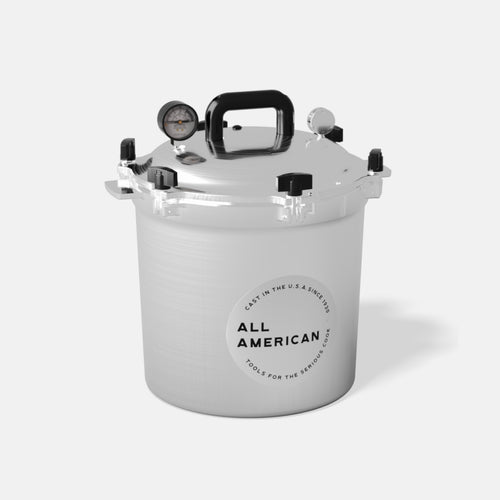
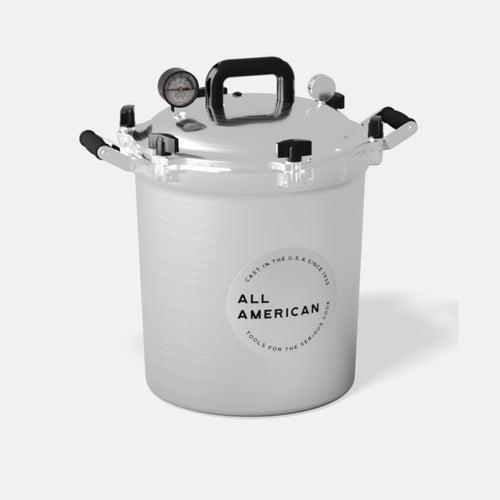
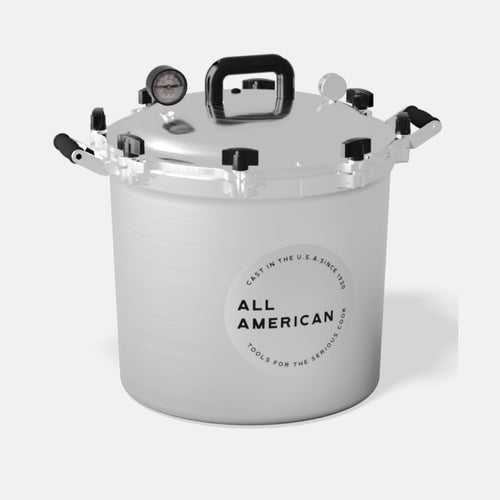
Here's the feature that makes All American 1930 pressure canners truly one of a kind: our exclusive, precision-machined metal-to-metal sealing system.
Other pressure canners on the market relies on a rubber or silicone gasket to form the seal between the lid and the pot. Those gaskets dry out. They crack. They degrade over time. They need to be replaced — sometimes at inconvenient moments, right before a big canning day.
All American 1930 canners work differently. Our lids and pots are precision-machined so that the metal surfaces form a perfectly matched, steam-tight seal — no gasket required. Positive-action clamping wing nuts lock the cover to the base, creating a seal that is both incredibly secure and remarkably easy to open and close.
What does that mean for you? It means you never have to buy a replacement gasket. Ever. All American 1930 canners are genuinely designed to be passed down through your family, a legacy-grade tool that gets better the more it's used.
When you invest in an All American 1930, you're not buying a product. You're buying a tradition.
Is Pressure Canning Safe?
This is the question nearly every newcomer asks — and it's a great one. Yes, pressure canning is absolutely safe when you follow tested recipes and use a quality canner. The process has been refined by decades of food science and is endorsed by the USDA as the definitive safe method for home preservation of low-acid foods.
Modern pressure canners like the All American 1930 are engineered with multiple safety features — the canner lid, the pressure gauge, the regulator weight, and an overpressure plug that releases excess pressure if the unit becomes over pressurized — that work together to ensure the process stays controlled from start to finish. These aren't afterthoughts; they're built into every canner we make.
Pressure canners are pressurized vessels and should always be used exactly as directed. The most important safety rule in pressure canning is simple: always use a tested, approved recipe from a trusted source — like the USDA Complete Guide to Home Canning or the National Center for Home Food Preservation. Processing times are determined by science, not guesswork, and they exist for a reason. Pressure cookers are not the same as pressure canners, and they are not the only canners approved for home canning.
Ready to Get Started with a Pressure Canner?
Here's the honest truth about pressure canning: the first time feels like a lot. There are new terms, a new piece of equipment, and a process that requires your attention. That's normal — and it passes quickly.
By your second batch, you'll be moving with confidence. By your fifth, it will feel like second nature. And when you open your pantry to find rows of jars filled with food you've grown, cooked, and preserved yourself — shelf-stable canned food that supports meal planning without taking up freezer space, with food cans or home-canned staples making it easier to pull together meals with pantry basics like rice — there is no feeling quite like it. It also simplifies cooking, since canned vegetables, canned tomatoes, or canned soups can help with quick weeknight dinners.
Pressure canning is practical, empowering, and deeply satisfying. And with an All American 1930 at your side — a canner built with no gaskets to replace, no compromises to make, and enough heirloom quality to outlast you — you're starting from the very best place possible.
Welcome to the community. Let's get canning.